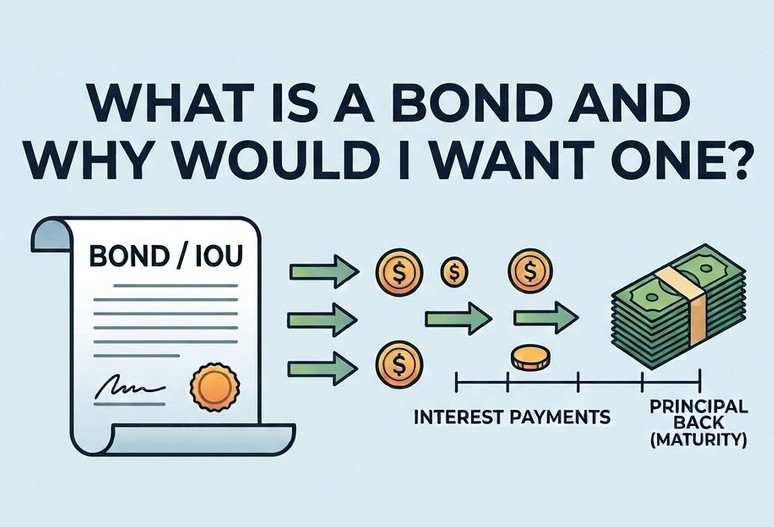
A bond is basically an IOU. You give someone money today, and they promise to pay you interest for a certain amount of time and then give your money back at the end. The “someone” might be the U.S. government, a state, a city, or a company. If you buy a $10,000 bond paying 5% for 10 years, you are essentially saying, “Fine. You can use my $10,000 for 10 years, but you owe me $500 a year, and at the end I want my $10,000 back.”
If that sounds familiar, it should. It is basically the opposite side of a car loan. When you finance a car, the bank gives you money and you pay the bank interest. When you buy a bond, you are the bank. You give someone else the money, and they pay you the interest. Same basic idea, except this time the monthly payment is coming toward you instead of leaving your checking account. That is a much nicer direction for money to travel.
So why buy bonds? Mostly because they can provide predictable income and stability. Stocks are wonderful long-term wealth-building tools, but they can also behave like a private fresh out of basic training after three energy drinks. Bonds generally have a more boring job. They are there to pay you interest, return your principal at maturity, and help keep your portfolio from bouncing all over the place.
This is also where people get unnecessarily upset about bonds. A bond is not a stock. If you buy an individual bond intending to hold it until maturity, you generally should not stare at its market price every afternoon wondering whether you made a terrible mistake. You bought it because you liked the deal when you bought it. If you agreed to lend the Treasury $10,000 for 10 years at 5%, and 5% met your needs, then the fact that the bond might show a market value of $9,700 or $10,300 six months later may not matter much if you still intend to collect the interest and hold it to maturity. You made the deal. The mission has not changed. No need to call headquarters because the screen turned red.
But why does the price move at all? This is one of the most important things to understand about bonds.
Imagine you own a $1,000 bond paying 4%, so it pays you $40 per year. Tomorrow, new bonds come out paying 5%. Nobody wants to pay you $1,000 for your old bond paying $40 when they can buy a brand-new $1,000 bond paying $50. Your bond is now the ugly house on the block. To make someone interested, its price has to fall.
For example, if your $40 annual payment stayed the same but the bond’s market price fell to around $800, that $40 payment would represent a 5% yield on the new price. The bond did not suddenly become defective. The market simply adjusted its price so the return became competitive with newer bonds.
The opposite happens when rates fall. Say you own a bond paying 5%, and new bonds are only paying 3%. Now your old 5% bond suddenly looks pretty attractive. People may be willing to pay more than $1,000 for it because it produces more income than the new bonds available in the market. So bond prices and interest rates generally move in opposite directions. When rates go up, existing bond prices go down. When rates go down, existing bond prices go up.
This matters even more when you own a bond fund instead of an individual bond.
A lot of investors treat “bonds” as if they are one giant asset class. They decide they want 30% bonds, buy some bond ETF, and move on. That can be a mistake because one of the most important characteristics of a bond fund is its duration.
Duration is basically a measure of how sensitive a bond or bond fund is to changes in interest rates. It is usually expressed in years. A bond fund with a duration of around two years should move much less when rates change than a bond fund with a duration of eight or nine years.
Here is a rough rule of thumb. If a bond fund has a duration of eight years and interest rates rise by 1%, the fund could fall by roughly 8%. If rates fall by 1%, it could rise by roughly 8%. It is not exact, but it is close enough to understand what is happening.
That is a very different experience from a short-term bond fund with a duration of two years, which might move only around 2% for the same 1% change in rates.
So when you put money into bonds, do not just say, “I need some bonds,” and dump money into the first bond ETF you recognize. Ask what job that money is supposed to do. Is it money you might need in two years? Five years? Ten years? Are you trying to create income? Reduce volatility? Match future expenses? Protect money you cannot afford to have bouncing around?
The duration should match the mission.
Sometimes a bond ETF is exactly the right tool. It is diversified, inexpensive, easy to trade, and professionally maintained. But sometimes individual bonds make more sense, especially if you have a specific future spending need. If you know you need $20,000 in five years, buying a bond that matures around that date can be very clean. You know approximately what you are getting, when you are getting it, and why you bought it. There is something to be said for simplicity.
Where you hold bonds matters too.
In most cases, bonds belong in tax-deferred accounts such as traditional IRAs and 401(k)s rather than taxable accounts or Roth accounts. The reason is taxes.
Most bond interest is taxed as ordinary income. If you are in the 22% tax bracket, a dollar of taxable bond interest may lose 22 cents to federal income tax before considering anything else. Stock gains held long enough may instead qualify for lower long-term capital gains rates.
That makes your traditional IRA a pretty good home for bonds. The interest can compound without generating a tax bill every year. It also helps lower your eventual Required Minimum Distributions.
Your Roth IRA is often better used for assets with higher long-term growth potential. Roth money may never be taxed again, so you generally want the assets with the greatest expected growth occupying that valuable real estate. Putting your slowest-growing assets in the Roth can be like asking a Patriot missile to attack a drone. They can do it, but it may not be the best use of the resource.
There are exceptions. Municipal bonds (if you are in tax bracket >24%) may make sense in taxable accounts. Treasury securities receive favorable state-tax treatment. Your personal tax bracket, retirement plan options, and overall portfolio all matter. But as a general starting point, taxable bonds often fit well in tax-deferred accounts, while higher-growth equities often fit well in Roth accounts.
Then retirement arrives and things get slightly more interesting.
You may hear that retirees should “spend the bonds first” when stocks are down. The idea makes sense. If the stock market has fallen 25%, you may not want to sell stocks at depressed prices to pay for groceries. You would rather spend from your more stable assets and give the stocks time to recover.
But what if all your bonds are sitting inside your traditional IRA?
You do not necessarily have to sell the bonds inside the IRA and withdraw that money. Doing so may create ordinary taxable income.
Instead, you can use the whole portfolio.
Suppose you have $500,000 in taxable investments and another $500,000 in your traditional IRA. Your target allocation is 60% stocks and 40% bonds. Most of the bonds are in the IRA because that is where they are tax-efficient.
Now you need $50,000 to live on, and you want that withdrawal economically to come from the bond side of the portfolio.
You could sell $50,000 of stocks in your taxable account. If those shares have gains, they may receive favorable long-term capital gains treatment. Then, inside your traditional IRA, you sell $50,000 of bonds and use that money to buy stocks.
What just happened?
Across the entire portfolio, you effectively spent $50,000 from bonds.
You sold stocks in taxable, but then replaced those stocks inside the IRA by moving $50,000 from bonds into stocks. Your overall stock allocation stays roughly where you wanted it, your bond allocation drops by the amount you spent, and your actual cash withdrawal came from the taxable account where the tax treatment may be better.
This is why asset allocation should be viewed across all of your accounts together rather than treating each account as its own little army.
Your taxable account, traditional IRA, Roth IRA, and 401(k) are different units, but they are all fighting the same war.
Bonds are not glamorous. Nobody is going to brag at a barbecue that their five-year Treasury paid exactly what it promised. But that is precisely the point. Bonds can provide income, stability, predictability, and flexibility. Just understand what you are buying.
Know the interest rate. Know the maturity. Know the duration. Know what job the bond is supposed to perform. And if the bond is still doing exactly what you hired it to do, do not fire it just because its market price moved around for a while.
Visit Kirk Reagan, CFP®, ChFC®, MQFP®, at High Flight Financial If you need help with your portfolio, the MQFPs listed here can help you with that.